The basics of foam fire suppression systems (Foam)
Hydrocarbon fires occur more often due to the volatile nature of hydrocarbons and their insoluble properties in water and being lighter than water, so these fires cannot be extinguished with water. When a Hydrocarbon fire occurs, if water is used to extinguish the fire, due to its lighter mass, the hydrocarbon will float to the top and continue to burn. And because thanks to water, the fire will flow from one place to another.
Air bubble fire suppression system is a fire suppression system that does not require the use of water. In some situations, water can be the cause of fire spread; For example, electrical fires or gasoline fires. At these fires, an automatic fire suppression system is extremely important and must be provided, but water should not be used. These challenges can be met by air bubble fire suppression systems.
Therefore, plants that use hydrocarbons must be protected by a nozzle fire suppression system using air bubbles designed according to NFPA 16
Air bubbles must be applied at a minimum density of 6.5 lpm/m2 on the open surface of the project.
The minimum pressure must be 1.4 bar at the nozzles of the far branches. However, the nozzle pressure of the near branches must not exceed 3.5 bar.
Nozzles should be installed in rows at ceiling height and no more than 3m apart.
The automatic spray heads have a glass bulb connected to the deluge valve to help the system operate automatically. These nozzles usually have an operating range of 68-79 degrees Celsius depending on the environmental temperature at the factory.
For concentrated air bubbles (AFFF 3%), the tank will be made of SUS 304 stainless steel with air bubble filler, air bubble suction tube and air bubble level glass. The air bubbles must be enough for the system to operate for 10 minutes.
To mix concentrated foam with water, a foam mixer is provided near the foam tank. A foam mixer of suitable capacity shall be provided downstream of the overflow valve so that when water flows through the mixer, the water flow will carry the concentrated foam with it.
Detailed operation of the air bubble system
To maintain a fire, three elements are needed: fuel (burning substance), fire or spark (energy) and Oxygen (inflammable substance). These three elements are the foundation of combustion, also known as the "Fire Triangle". If one of these elements is absent, combustion cannot take place. The air bubble fire suppression system will isolate Oxygen from the other two elements.
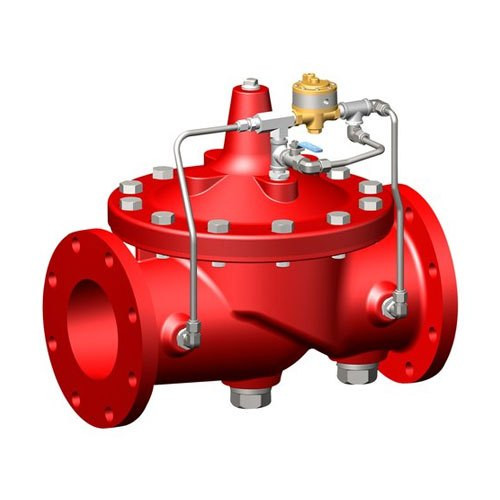
When the automatic spray head breaks due to high temperature, the water in the pipe will flow out and open the overflow valve. As soon as the overflow valve opens, water will mix with air bubbles in the air bubble mixer, and this water and air bubble solution will flow to the air bubble nozzles hung on the ceiling of the factory. At the nozzles, foam will be created by the impact of air, and this final foam product will be sprayed onto the fire.
This air bubble flows through the pipes, under pressure and sprays directly into the burning fuel or fire, through the nozzles. The foam covers the fuel like a curtain and isolates oxygen. The fire triangle has now been broken.
The fire will be extinguished because air bubbles cover the fire and isolate it from the air. Thanks to the application of air bubble firefighting, fires caused by hydrocarbons, oil, paint... will be completely extinguished.
The system's operating signal must be displayed on the control cabinet, along with the alarm signal.
Note: When the air bubbler detects a fire, it will be activated. The water in the system will flow into the system. Concentrated air bubbles will flow into the system through the mixer. The mixer will maintain the percentage concentration of the air bubble solution. Air bubble solution will be formed when concentrated air bubbles are mixed with water in the right ratio.

Types of "type B" air bubbles:
Aqueous Film-Forming Foam (AFFF): This is a high quality air foam. Widely used in oil refinery projects, airports, and manufacturing plants. They can be used flexibly by many different means.
High expansion air bubble: Used in very large areas. Not only the area, they also cover a fairly large height. Therefore, they are used for areas that need three-dimensional protection such as warehouses or ships. They appear to be very effective against oil spill fires or hydrocarbon fires.
Advantages of Foam Spray System
- The entire area will be covered with air bubbles, so it is very effective for fires in toxic areas, factories, in fire tanks... where people can hardly access.
- Ability to react quickly.
- Damage due to fire is kept low Because the fire area is covered by air bubbles and is also cooled by water, the possibility of fire spreading is negligible.
- The fire can be completely extinguished without human intervention.
Source: https://instrumentationtools.com/basics-foam-fire-fighting-system/
Abridged translation: Khanh An